
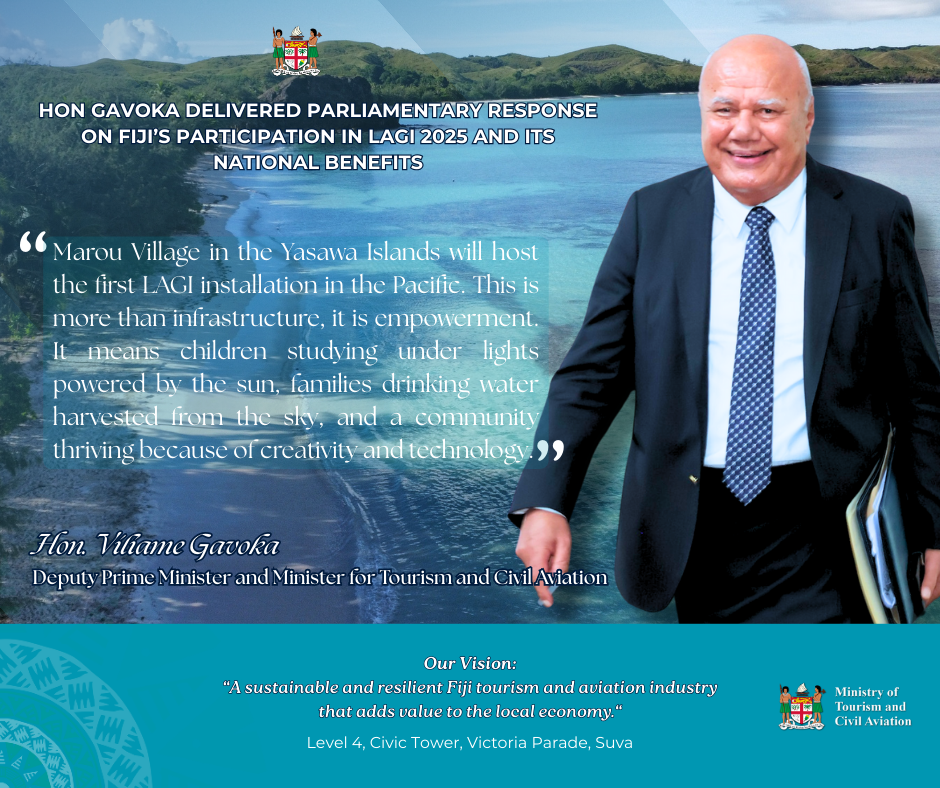
𝐇𝐨𝐧 𝐆𝐚𝐯𝐨𝐤𝐚 𝐃𝐞𝐥𝐢𝐯𝐞𝐫𝐞𝐝 𝐏𝐚𝐫𝐥𝐢𝐚𝐦𝐞𝐧𝐭𝐚𝐫𝐲 𝐑𝐞𝐬𝐩𝐨𝐧𝐬𝐞 𝐨𝐧 𝐅𝐢𝐣𝐢’𝐬 𝐩𝐚𝐫𝐭𝐢𝐜𝐢𝐩𝐚𝐭𝐢𝐨𝐧 𝐢𝐧 𝐋𝐀𝐆𝐈 𝟐𝟎𝟐𝟓 𝐚𝐧𝐝 𝐈𝐭𝐬 𝐍𝐚𝐭𝐢𝐨𝐧𝐚𝐥 𝐁𝐞𝐧𝐞𝐟𝐢𝐭𝐬
𝟐𝟒 𝐍𝐨𝐯𝐞𝐦𝐛𝐞𝐫 𝟐𝟎𝟐𝟓 – The Deputy Prime Minister and Minister for Tourism and Civil Aviation, Hon. Viliame Gavoka, delivered an update in Parliament while responding to Hon. Ratu Isikeli Tuiwailevu’s question on Fiji’s participation and involvement in the Land Art Generator Initiative 2025 Fiji Exhibition. The minister outlined how the program supported national goals in climate resilience and sustainable tourism.
LAGI is a nonprofit based in the United States. It was founded in 2008 by Elizabeth Monoian and Robert Ferry. Its work focuses on public art that produces renewable energy and clean water. LAGI has delivered international design competitions and community co-design projects in Abu Dhabi, New York, Copenhagen, Santa Monica, Melbourne, and Mannheim. The initiative brings together artists, architects, and engineers to design installations that produce clean electricity, harvest potable water, and serve as cultural sites.
Fiji hosted the first LAGI design competition in the Pacific. The Fiji Arts Council launched the LAGI 2025 Fiji Exhibition earlier this year. The Minister informed Parliament that the competition drew global participation and delivered two winning designs, The O and Ligavatuvuce. The prototypes were engineered to generate about 150 MWh and 120 MWh of clean energy each year. They were also designed to harvest about 1.2 million liters and 4.5 million liters of drinking water each year.
The Minister reported that Marou Village in the Yasawa Islands was selected to host the first LAGI installation in Fiji. He noted that the project supported the village’s energy needs and water security objectives. He added that the installation would serve as a model for other communities.
The update outlined how LAGI aligned with the National Sustainable Tourism Framework and the National Development Plan. The Minister stated that installations created through LAGI would enhance Fiji’s tourism offering by adding cultural and educational visitor sites. He added that the project supported Fiji’s climate commitments presented at COP30.
The Minister concluded by highlighting the broader value of the initiative. He noted that the installation would support local employment, strengthen community infrastructure, and position Fiji as an advocate for practical climate solutions.
Click here to read more of the Parliament Response: https://shorturl.at/StoDN
#SustainableTourism #BluePacificVision #CultureAndClimate #FijiLeads #InnovationWithIntegrity #EmpoweringCommunities #ArtThatWorks #BeautyThatSustains
ENDS