
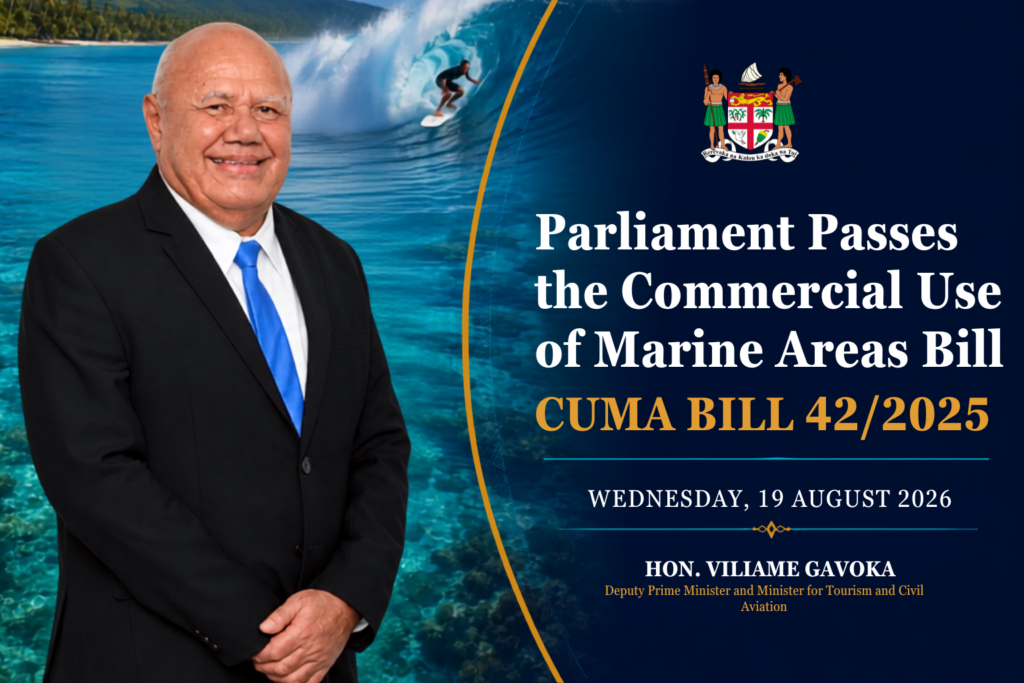
PARLIAMENT PASSES THE COMMERCIAL USE OF MARINE AREAS BILL 42 of 2025
Bill No. 42 of 2025 clears its final reading following nationwide public consultation led by the Parliamentary Standing Committee on Justice, Law and Human Rights
SUVA, 19 AUGUST 2026 – Parliament last night passed the Commercial Use of Marine Areas Bill (Bill No. 42 of 2025), setting the framework for the use of Fiji’s marine areas designated for commercial tourism.
The Bill establishes a process for the reversion of proprietary ownership of marine areas used for commercial purposes to relevant iTaukei customary owners and modernises the management of marine spaces used for tourism. It provides for the repeal of the Regulation of Surfing Areas Act 2010 and puts in place new arrangements for the use of these areas by commercial operators.
The Bill was gazetted on 1 December 2025 under Gazette Notice No. 91 and referred to the Parliamentary Standing Committee on Justice, Law and Human Rights. The Committee conducted nationwide public consultations on the draft Bill, with the support of the Ministry of Tourism and Civil Aviation.
The Committee’s engagement spanned the length of the country, drawing voices from urban centres and rural coastal communities alike. Resource owners, tourism operators, surfers and other interested parties put their views on record in writing and in person, and that body of feedback shaped how the Committee weighed the Bill.
Introducing the Bill in Parliament, the Deputy Prime Minister and Minister for Tourism and Civil Aviation, Hon. Viliame Gavoka, said the reform would modernise the management of Fiji’s marine spaces and strengthen the participation of Indigenous communities in the tourism sector. The Ministry committed to an active role in both conservation and development throughout the consultation process.
The Bill will now be presented to His Excellency the President for assent. Once assented to and published in the Gazette, it becomes an Act of Parliament. Its provisions take effect once the Commencement Notice is published. Until then, existing laws remain unchanged, and the Ministry encourages stakeholders to continue engaging through the established channels.
– ENDS –