𝐍𝐚 𝐕𝐮𝐚𝐥𝐢𝐤𝐮 𝐏𝐥𝐚𝐧 𝐒𝐞𝐭𝐬 𝐎𝐮𝐭 𝐚 𝐌𝐚𝐧𝐚𝐠𝐞𝐝 𝐓𝐨𝐮𝐫𝐢𝐬𝐦 𝐅𝐮𝐭𝐮𝐫𝐞 𝐟𝐨𝐫 𝐭𝐡𝐞 𝐍𝐨𝐫𝐭𝐡
𝘐𝘯𝘵𝘦𝘨𝘳𝘢𝘵𝘦𝘥 𝘛𝘰𝘶𝘳𝘪𝘴𝘮 𝘔𝘢𝘴𝘵𝘦𝘳 𝘗𝘭𝘢𝘯 𝘧𝘰𝘳 𝘝𝘢𝘯𝘶𝘢 𝘓𝘦𝘷𝘶 𝘢𝘯𝘥 𝘛𝘢𝘷𝘦𝘶𝘯𝘪 𝘳𝘦𝘤𝘰𝘮𝘮𝘦𝘯𝘥𝘴 𝘦𝘹𝘱𝘢𝘯𝘥𝘦𝘥 𝘣𝘶𝘵 𝘮𝘢𝘯𝘢𝘨𝘦𝘥 𝘥𝘦𝘷𝘦𝘭𝘰𝘱𝘮𝘦𝘯𝘵 𝘵𝘰 2050
𝐒𝐮𝐯𝐚, 𝟏 𝐎𝐜𝐭𝐨𝐛𝐞𝐫 𝟐𝟎𝟐𝟔 – The Integrated Tourism Master Plan being prepared under the Na Vualiku programme outlines a future in which tourism growth in the Northern Division supports local communities, protects natural and cultural assets, and creates opportunities for people to earn a living closer to home.
Responding to Oral Question 232/2026 in Parliament on 30 September, Deputy Prime Minister and Minister for Tourism and Civil Aviation, Hon. Viliame R. Gavoka, said the plan looks ahead to 2050 and is being shaped by evidence and consultation with the people of Vanua Levu and Taveuni.
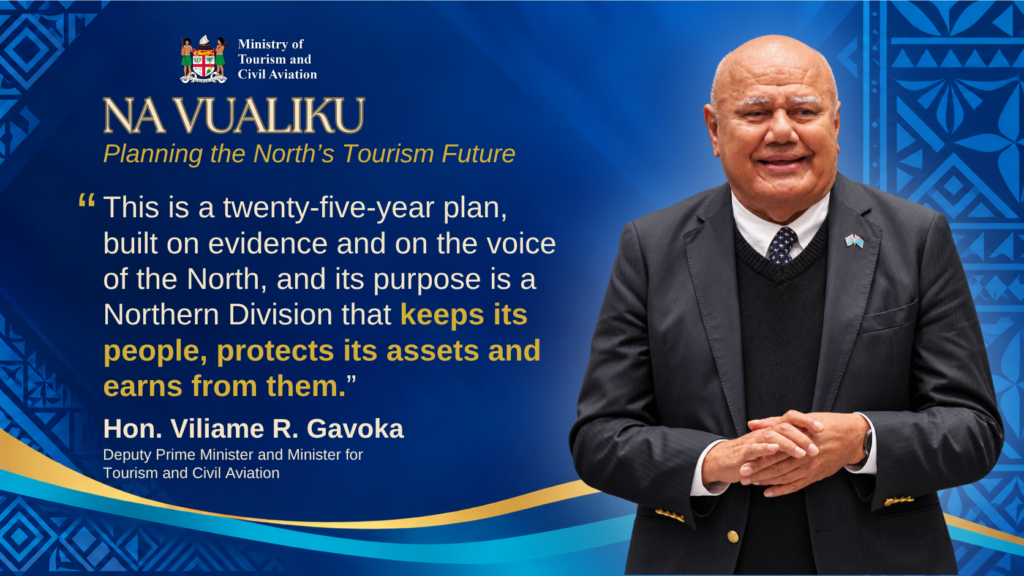
“This is a twenty-five-year plan, built on evidence and on the voice of the North, and its purpose is a Northern Division that keeps its people, protects its assets and earns from them,” Hon. Gavoka said.
The consultants assessed five development pathways and recommended “expanded but managed development”. This would improve existing airports and essential services, support accommodation at the upper end of the market, and keep growth within the capacity of the North’s reefs and forests.
Under the recommended pathway, modelling indicates approximately 130,000 tourism arrivals annually by 2050, compared with about 72,000 today. Annual tourism spending could grow from an estimated $290 million to around $1 billion, with growth driven mainly by international visitors who stay longer and spend more. Community-based tourism is also modelled to almost double.
These figures are projections under the recommended pathway. The choice of pathway rests with Government, and the completed plan will be brought to Cabinet.
Hon. Gavoka said communities had made clear that they did not want rapid, uncontrolled growth. Their priorities included community ownership and participation, protection of natural and cultural assets, and essential infrastructure before or alongside tourism development.
“The government’s role is to put those foundations in place first,” he said.
Financed by the World Bank, Na Vualiku’s first phase is progressing airport engineering and design work, alongside studies on a possible new airport for Vanua Levu and the scope to expand Savusavu Airport. The Fiji Roads Authority has also invited tenders for the design and supervision of the Cross-Island Road project between Labasa and Savusavu, including four scenic lookout points.
Destination improvements include a visitor centre, tracks and trails at Waisali Rainforest Reserve; beautification of the Savusavu foreshore and parts of Labasa; and small-scale infrastructure for community-based tourism organisations across Vanua Levu and Taveuni.
Solar projects for Savusavu Market, Labasa Craft Market and Savusavu Hospital have passed feasibility and are moving to tender. Design work for a new Savusavu landfill and rehabilitation of the existing dump is also under way.
A contract signed on 24 September provides for a 15-month capacity-building programme for micro, small and medium enterprises across Vanua Levu. An International Visitor Survey is being funded throughout the phase to inform decisions about visitor markets, length of stay and spending.