DPM Gavoka Opens Pacific Polytech Training Hotel
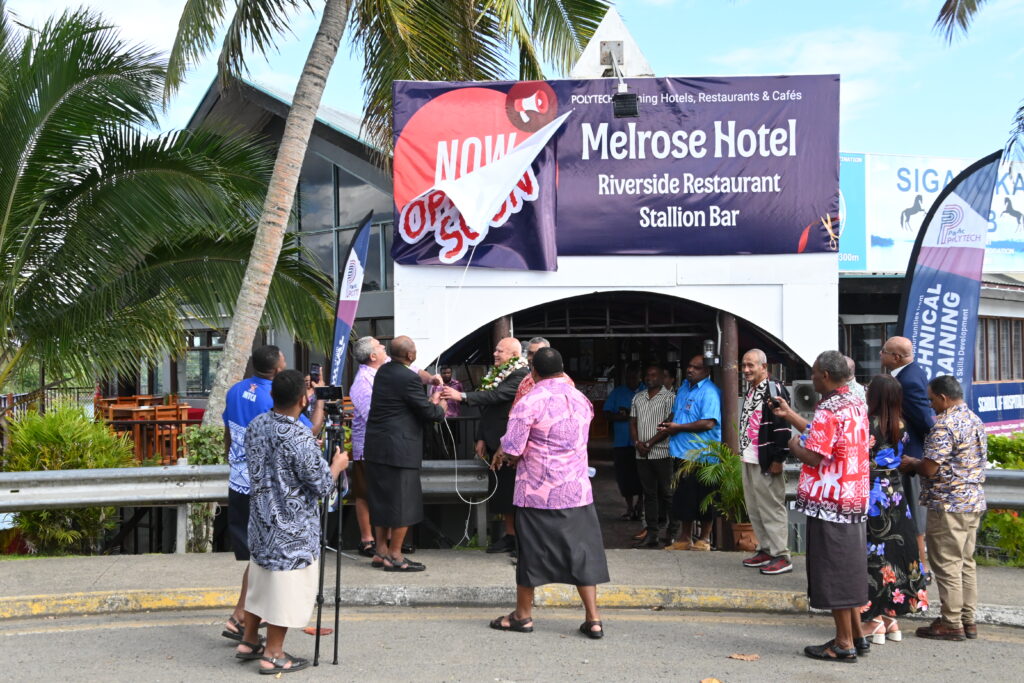
SIGATOKA, 28 August 2026 – Deputy Prime Minister and Minister for Tourism and Civil Aviation Hon Viliame Gavoka opened Pacific Polytech’s Melrose Hotel here Friday, a working hotel that takes paying guests while students staff the front desk, the kitchen and the floor under supervision. Gavoka called the opening personal as well as official. “Sigatoka is my hometown,” he said. “In Suva, I am the Deputy Prime Minister. Here, I am simply one of your own, and there is no title I am prouder to carry.”
“A hotel is bricks and mortar,” Gavoka said. “A training hotel is something more. It is a classroom with real guests, real service and real standards, and that is what we open today.” The goal, he said, is for graduates to already “know the work” before they walk into a resort in Denarau or the Mamanucas.
Gavoka framed the hotel as a direct response to Fiji losing trained workers overseas. “We are proud that a Fijian is wanted abroad for their skill and their character,” he said. “But when a trained chef or a licensed engineer leaves and is not replaced, the business that trained them is left short, and the country is left poorer.” His answer is volume, not restriction. “The answer is not to lock our people in,” he said. “It is to train more of them, and to train them well, so that our pipeline fills faster than it empties. If we lose one supervisor, we must be producing three.”
Pacific Polytech was formed to fill the gap left when the Technical Colleges of Fiji closed in late 2020 and early 2021. It opened its first campus in Tavua in 2021 and has since grown into a network of campuses from Lami to Labasa. The institution graduated 1,370 students in 2025; that figure is projected to reach 2,033 this year. It now holds 15 national qualifications and 22 provider qualifications.
The training pipeline matters to an industry that carries Fiji’s economy. The Fiji Bureau of Statistics recorded a record 986,367 visitor arrivals in 2025, generating $2.81 billion in tourism earnings. Tourism is Fiji’s largest industry and largest private employer, and it sits at the centre of the National Development Plan 2025 to 2029, Vision 2050 and the National Sustainable Tourism Framework 2024 to 2034.
The opening follows a run of legal reform to the sector: Fiji’s first Tourism Act, enacted in June 2026; the Commercial Use of Marine Areas reform, which returns ownership of commercial marine areas to customary iTaukei owners; and a new Civil Aviation Master Plan for Fiji covering 2026 to 2031, with a Civil Aviation Bill in development.
“Government sets the policy and the law,” Gavoka said. “Institutions like this one build the people.” Careers have to be worth staying for, he added, with a real wage, a path to promotion and dignity in the work. “Good policy is written in Suva, but it is proven in places like Sigatoka. A law passed in Parliament means little until a trained young Fijian is ready to carry it out on the floor of a hotel.”
– ENDS –